Simulation of an espresso filter using Brinkmann-Forchheimers equation
During my last semester in Systems Engineering, I took the course ‘Advanced Analysis and Numerics’ with a focus on Partial Differential Equations (PDEs). The end of term exam was a group project and each group of three was given a different problem to solve. My group was given the task of calculating the flow rate and pressure drop inside an espresso filter in 2D using Python and NGsolve. We were given the geometry of the filter and the first step was to solve for the weak equation (we solve for a time-independent solution). We then implemented the solver in Python and solved for different initial conditions, the ratio of water to coffee in the filter and the size and number of holes in the filter.
Read the full report in german here
Brinkmann-Forchheimer Equation
\begin{equation} \tag{1} \frac{1}{\varphi}\partial_t \boldsymbol{u} + \frac{1}{\varphi^2}(\boldsymbol{u} \cdot \nabla)\boldsymbol{u} - \frac{\nu}{\varphi}\Delta\boldsymbol{u} +\frac{1}{\varrho} \nabla p + \frac{\nu}{K}\boldsymbol{u} + \frac{c_F}{\sqrt{K}}\vert \boldsymbol{u} \vert \boldsymbol{u} = 0 \end{equation}
\begin{equation} \tag{2} \nabla \cdot \boldsymbol{u} = 0 \end{equation}
Variables and Constants
Variables:
\(\boldsymbol{u}\) : Flowrate \(\left[\frac{\text{m}}{\text{s}}\right]\)
\(p\) : Pressure \(\left[\text{Pa} = \frac{\text{kg}}{\text{m}\cdot{s}^2}\right]\)
Constants:
\(\varphi\) : Fraction of Fluid \(4\in [0,1]\) \(\left[-\right]\)
\(\nu\) : Dynamic Viscosity \(\left[\frac{\text{m}^2}{\text{s}}\right]\) \(\left(\text{for Water @ 90°C} = 3.248 \cdot 10^{-7}\:\frac{\text{m}^2}{\text{s}}\right)\)
\(\varrho\) : Density \(\left[\frac{\text{kg}}{\text{m}^3}\right]\) \(\left(\text{for Water @ 90°C} = 965.31\:\frac{\text{kg}}{\text{m}^3}\right)\)
\(\text{K}\) : Permeability \(\left[\text{m}^2\right]\)
\(c_F\) : Forchheimerconstant \(\left[-\right]\)
\(d_P\) : Particle diameter \(\left[\text{m}\right]\)
\(\alpha, \beta\) : Form factors (are determined empirically, we use: \(\alpha = 1.75, \beta = 150\))
Boundary conditions
The flow at the inlet of the filter is calculated as follows:
\(A = \frac{d^2*\pi}{4} = \frac{(0.04 \text{m})^2*\pi}{4} = 0.00126\text{m}^2\)
\(u_{\text{in}} = \frac{V}{t\:A} = \frac{3e^{-5}\text{m}^3}{15\text{s}\cdot 0.00126 \text{m}^2} = 0.00159\: \text{m/s}\)
The boundary conditions for the flow velocity are given by
\(\partial \Omega = \Gamma_{\text{Wall}}+\Gamma_{\text{Inlet}}+ \Gamma_{\text{Outlet}}\)
\(\boldsymbol{u}(\boldsymbol{x}) = 0 \quad \text{on}\: \Gamma_{\text{Wall}}\)
\(\boldsymbol{u}(\boldsymbol{x}) = (0,-u_{\text{in}}) \quad \text{on}\: \Gamma_{\text{Inlet}}\)
and the remaining boundary conditions are deliberately left open.
Weak Equation
For the discretisation of the flow \(\boldsymbol{u}\) we use a continuous 2nd order H1-vector discretisation with additional inner order 3 and for the pressure a discontinuous 1st order discretisation.
\(\boldsymbol{u}(\boldsymbol{x})\in V = P^{2+} \subset H^1(\Omega)\)
\(p(\boldsymbol{x}) \in Q = P^{1,dg} \subset H^1(\Omega)\)
The strong equation is given by:
\begin{equation}
\tag{3}
\frac{1}{\varphi^2}(\boldsymbol{u} \cdot \nabla)\boldsymbol{u} - \frac{\nu}{\varphi}\Delta\boldsymbol{u} +\frac{1}{\varrho} \nabla p + \frac{\nu}{K}\boldsymbol{u} + \frac{c_F}{\sqrt{K}}\vert \boldsymbol{u} \vert \boldsymbol{u} + \nabla \cdot \boldsymbol{u} = 0.
\end{equation}
We neglect the time-dependent part of the equation, as we only calculate a stationary solution to the equation.
The individual components of the weak equation are calculated as follows:
\[\begin{aligned} \frac{1}{\varphi^2}(\boldsymbol{u} \cdot \nabla)\boldsymbol{u} &= \frac{1}{\varphi^2}(\partial_x u_x + \partial_y u_y) \boldsymbol{u} = \frac{1}{\varphi^2} \begin{pmatrix} (\partial_x u_x + \partial_y u_y) u_x \\ (\partial_x u_x + \partial_y u_y) u_y \end{pmatrix} = \frac{1}{\varphi^2} \begin{pmatrix} \langle \nabla u_x, u \rangle \\ \langle \nabla u_y, u \rangle \end{pmatrix} \\ &= \frac{1}{\varphi^2} \langle \nabla u, u \rangle \:\to \frac{1}{\varphi^2}\int_\Omega ((\nabla u)u)v \:d\boldsymbol{x}\quad \forall v \in V = P^{2+} \subset H^1(\Omega) \end{aligned}\] \[\begin{aligned}\frac{\nu}{\varphi}\Delta\boldsymbol{u} &= \frac{\nu}{\varphi} \begin{pmatrix} \Delta u_x \\ \Delta u_y\end{pmatrix} \: \to \frac{\nu}{\varphi}\int_\Omega \begin{pmatrix} \Delta u_x \\ \Delta u_y\end{pmatrix} \cdot \begin{pmatrix} v_x \\ v_y\end{pmatrix}\:d\boldsymbol{x} = \frac{\nu}{\varphi}\int_\Omega \begin{pmatrix} \nabla u_x \\ \nabla u_y\end{pmatrix} \cdot \begin{pmatrix} \nabla v_x \\ \nabla v_y\end{pmatrix}\:d\boldsymbol{x} \\ & = \frac{\nu}{\varphi}\int_\Omega \langle \nabla u, \nabla v \rangle \:d\boldsymbol{x} \quad \forall v \in V = P^{2+} \subset H^1(\Omega) \end{aligned}\] \[\begin{aligned} \frac{1}{\varrho} \nabla p\: \: \to \frac{1}{\varrho}\int_\Omega \begin{pmatrix} \partial_x p \\ \partial_y p\end{pmatrix} \cdot \begin{pmatrix} v_x \\ v_y\end{pmatrix}\:d\boldsymbol{x} &= \frac{1}{\varrho}\int_\Omega \partial_x p \:v_x + \partial_y p \: v_y \:d\boldsymbol{x} = \frac{1}{\varrho}\int_\Omega (\partial_x \:v_x + \partial_y \: v_y)p \:d\boldsymbol{x} \\ &= \frac{1}{\varrho}\int_\Omega (\nabla \cdot v)p \:d\boldsymbol{x} \quad \forall v \in V = P^{2+} \subset H^1(\Omega) \end{aligned}\] \[\frac{\nu}{K}\boldsymbol{u} \: \to \frac{\nu}{K}\int_\Omega u \: v\:d\boldsymbol{x} \quad \forall v \in V = P^{2+} \subset H^1(\Omega)\] \[\frac{c_F}{\sqrt{K}}\vert u \vert u \: \to \frac{c_F}{\sqrt{K}}\int_\Omega \vert u \vert u \: v\:d\boldsymbol{x} \quad \forall v \in V = P^{2+} \subset H^1(\Omega)\] \[\nabla \cdot \boldsymbol{u}\: \to \int_\Omega (\nabla \cdot \boldsymbol{u})\:q \:d\boldsymbol{x}\quad \forall q \in Q = P^{1,dg} \subset H^1(\Omega)\]This results in the complete weak equation \begin{equation} \tag{4} \begin{aligned} \int_\Omega \frac{1}{\varphi^2}((\nabla u)u)v + \frac{\nu}{\varphi} \langle \nabla u, \nabla v \rangle + \frac{1}{\varrho}(\nabla \cdot v)p + \frac{\nu}{K} u v + \frac{c_F}{\sqrt{K}} \vert u \vert u v + (\nabla \cdot \boldsymbol{u})q \quad d\boldsymbol{x} = 0 \quad \forall v \in V = P^{2+} \subset H^1(\Omega),\quad \forall q \in Q = P^{1,dg} \subset H^1(\Omega) \end{aligned} \end{equation}
Possible Solution
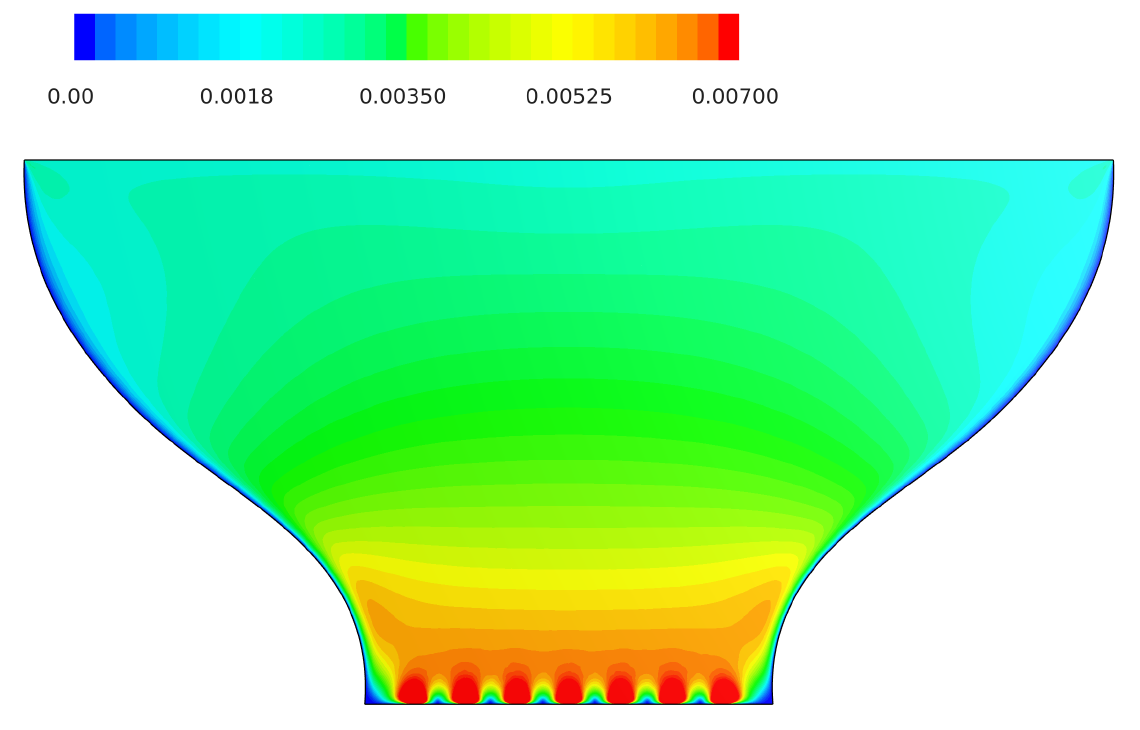
Here you can see a possible solution for the flow rate of an espresso filter with 7 holes in this plane: