Multi-group pedestrian flow
Bachelor Thesis Systems Engineering
I wrote my Bachelor Thesis at the Institute of Computational Physics at ZHAW, where I extended a continuum-based pedestrian model used to simulate evacuation scenarios for large buildings and events in order to identify dangerous situations early. My work was based on the pFlow model developed by R. Axthelm, who was the expert for my thesis and cooperated with my supervisors on this project. Parts of my findings were presented during the presentation of the entire project at the TGF 2024 Conference and lead to my first publication in the conference proceeding paper [1]. The Thesis was graded a 5.5 on the Swiss grading scale.
The pFlow model only used one homogeneous group in the simulation. It consists of two equations: the regularised form of the Eikonal Equation, which has been transformed to a Helmholtz Equation in order to make it more solvable using FEM. The Helmholtz Equation yields
\[-\delta^2 \Delta \Psi_\delta + \frac{1}{f^2(\varrho_\varepsilon)}\Psi_\delta = 0,\]which calculates the time between all point in a room to the exit based on the density distribution within the domain. Calculating the gradient of this field (the Eikonal) returns the direction of the path minimising the time to exit. The second equation is the Continuity Equation with an additional diffusion term
\[\frac{\partial\varrho_\varepsilon}{\partial t} -\varepsilon \Delta \varrho_\varepsilon + \nabla \cdot(\varrho_\varepsilon \boldsymbol{u}) = 0,\]which ensures that pedestrians within the domain can neither appear from nor disappear into nothing and only enter or leave the domain through the boundaries. The equations are linked through the velocity field
\[\boldsymbol{u} = f(\varrho_\varepsilon) \frac{\nabla\Psi_\delta}{\Vert\nabla\Psi_\delta\Vert}.\]The homogeneous group is characterised through its density \(\varrho_\varepsilon\) and its fundamental diagram \(f(\varrho_\varepsilon)\) which determines the pedestrians velocity based on the density surrounding them.
In my thesis I explored the possibility to have multiple groups with different characteristics interacting with each other within a domain. This allows mixing groups with varying velocities and different exits to reach. To achieve this behaviour we define a pedestrian density for each subgroup \(\varrho_k\) and define the total density as \(\varrho_\varepsilon = \sum \varrho_k\). We define a Continuity Equation for each group
\[\frac{\partial\varrho_k}{\partial t} -\varepsilon \Delta \varrho_k + \nabla \cdot(\varrho_k \boldsymbol{u}_k) = 0.\]Each group can be characterised through their specific fundamental diagram \(f_k(\varrho_\varepsilon)\) yielding their specific regularised Eikonal Equation
\[-\delta^2 \Delta \Psi_k + \frac{1}{f_k^2(\varrho_\varepsilon)}\Psi_k = 0,\]and their specific velocity field
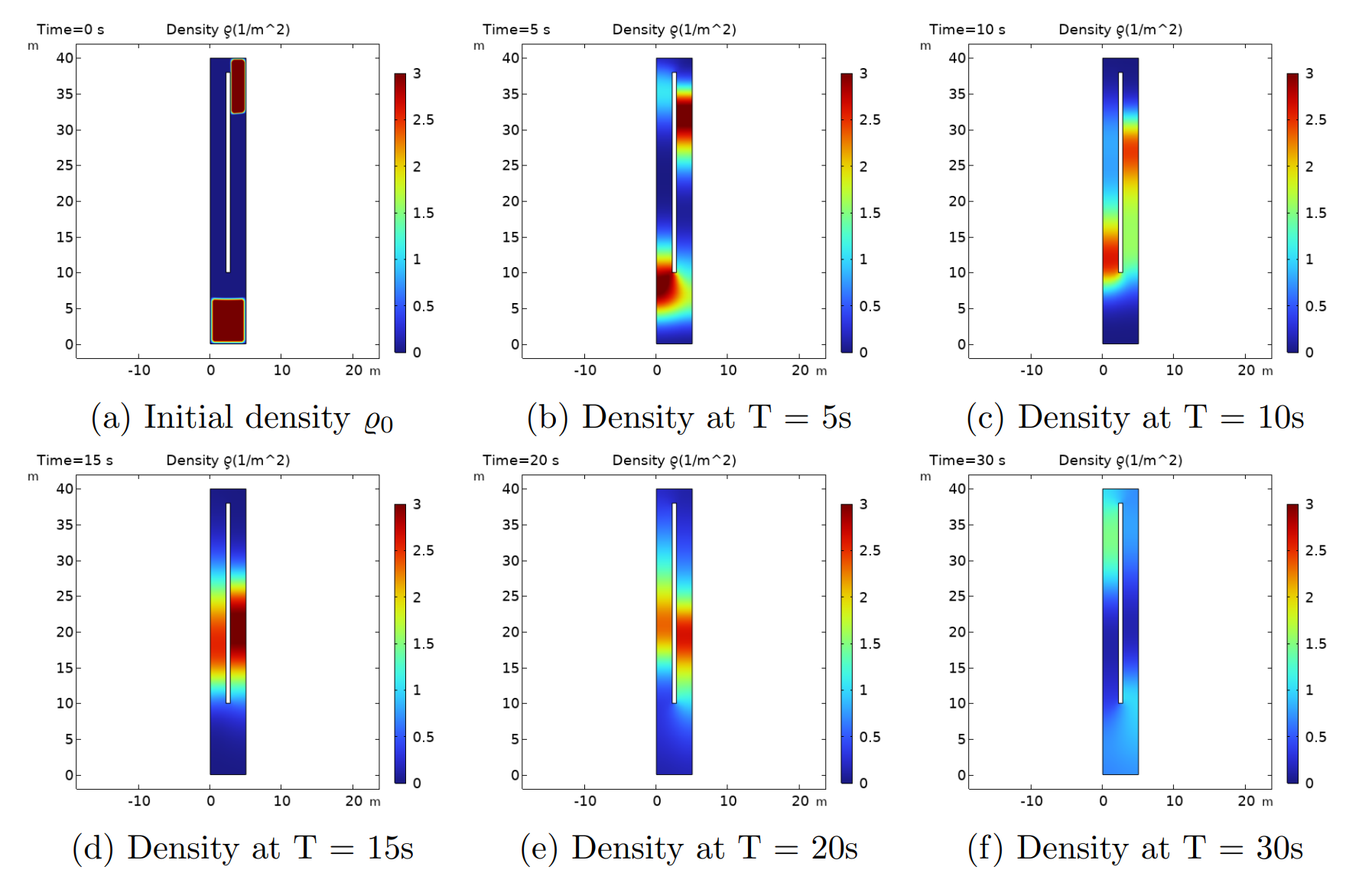
\[\boldsymbol{u}_k = f_k(\varrho_\varepsilon) \frac{\nabla\Psi_k}{\Vert\nabla\Psi_k \Vert}.\]Using this modified model, we are now able to simulate the following situation with two different groups passing through a corridor with divider in opposite direction. Notably, the group on the bottom favours the left side of the corridor due to the second group walking on the right side. Additionally, the groups have different exits assigned to each other. Both of these behaviors were not possible to simulate with the unmodified version of the pFlow model.